
Buyer's Guide · 9 min read
2019 Azimut 55 Fly Buyer's Guide: What to Inspect, What to Negotiate
What a working broker actually looks at before signing a purchase agreement on a 2019 Azimut 55 Flybridge — engines, gelcoat, electronics, and the price ranges that hold up in 2026.
By Michael Johnson ·
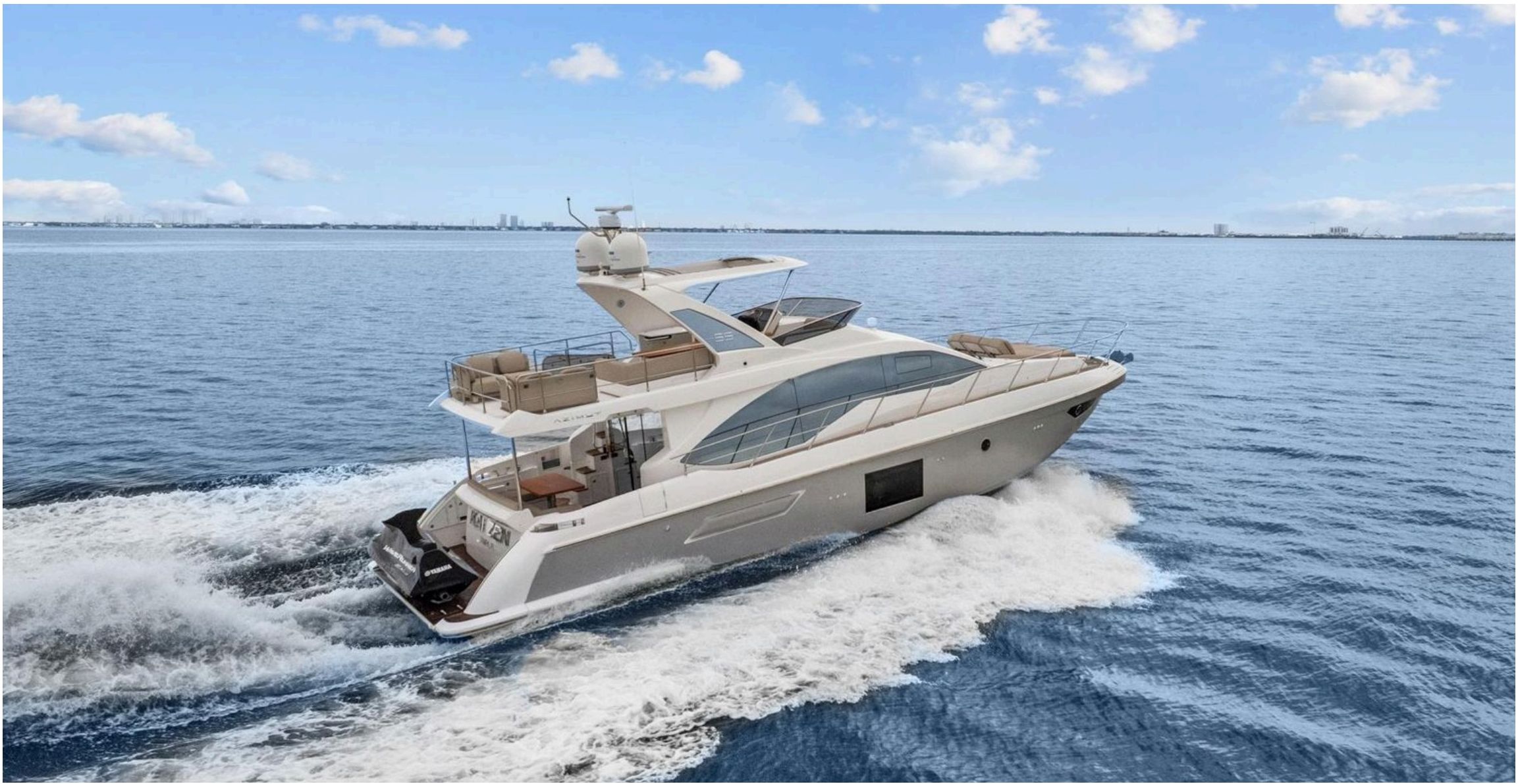
The Azimut 55 Flybridge has been one of the most consistently desirable mid-size Italian yachts on the U.S. brokerage market for the better part of a decade. The 2019 model year, in particular, sits in a sweet spot: it carries the refined Stefano Righini exterior and Carlo Galeazzi interior of the second-generation hull, ships with the well-sorted MAN V8-1000 propulsion package, and is now far enough into its life that the original owner has typically absorbed the steepest depreciation. This guide is the inspection checklist I personally walk through with buyers before we put a 2019 55 Fly under contract.
Start with the engines, not the cabinetry
Almost every 2019 55 Fly was delivered with twin MAN V8-1000 (1,000 hp) common-rail diesels. They are exceptionally reliable but they reward — and demand — disciplined service. The first thing I want to see is a continuous service binder: oil and filter changes every 250 hours, raw water impellers annually, valve lash checks at the manufacturer's interval, and turbo / aftercooler inspections on schedule. Boats that have lived in saltwater Florida, especially those that have run the Gulf, should also show recent heat-exchanger and aftercooler cleanings. Hours alone don't tell the story — a 700-hour boat with documented service is a far better buy than a 350-hour boat that has been napping at the dock.
Engine-room red flags
- Salt creep on the manifolds or turbo housings — usually a sign of a leaking riser or exhaust elbow.
- Weeping coolant at the heat exchanger end caps. Common, fixable, but a useful price-negotiation lever.
- Black soot trails on the transom around the exhaust outlets — points to injectors or aftercooler condition.
- A generator (typically a 17.5 kW Kohler or Onan) with fewer than 200 hours per calendar year. Generators that sit corrode faster than generators that run.
Hull, gelcoat, and the structural bits nobody photographs
Azimut's hull layup on this generation is solid GRP below the waterline with a balsa-cored deck and superstructure. That's industry-standard for the segment, but it means moisture mapping during the survey is non-negotiable. I want a competent surveyor to percussion-test the entire foredeck, the flybridge sole, and the swim platform underside, then back that up with a moisture meter on any suspect area. Repairs are not the end of the world — a properly documented core repair is fine — but undisclosed wet core is a deal-killer or a five-figure discount.
On the cosmetic side, look closely at the gelcoat where the hull meets the rub rail and around any deck hardware. Stress cracks radiating from a fastener are usually cosmetic. Cracks running parallel to a hull line, especially near the chine, deserve closer attention. The 2019 boats are old enough that any boat that has lived outdoors year-round in Florida will show some chalking on the hardtop — that's normal and a compound-and-polish will restore it.
Electronics: which generation are you really buying?
The 2019 55 Fly was delivered new with either a Raymarine Axiom Pro or a Garmin GPSMAP 8400-series glass bridge, typically with two displays at the lower helm and two on the flybridge, plus open-array radar, autopilot, AIS, and a thermal camera option. Six years on, both stacks are still supported but are no longer current. If the boat you're looking at still has the original suite, factor a $25,000–$45,000 electronics refresh into your numbers if you want to be on the current generation. Boats that have already been upgraded to current-gen Raymarine Axiom XL or Garmin 9000-series command a real premium and are worth it for a buyer who actually cruises.
What a fair 2026 price looks like
After two years of softening in the 50–60 ft European flybridge segment, 2019 Azimut 55 Fly transactions in 2026 are clearing in a fairly tight band. Boats with documented service, full electronics, low to moderate hours (under 800), and no significant cosmetic issues are trading between $945,000 and $1,025,000 in the Florida market. Boats with deferred maintenance, dated electronics, or visible cosmetic neglect are trading $80,000–$140,000 below that band. The vessel we currently represent sits cleanly in the upper half of the fair-market range and reflects its documented history and electronics generation.
Rule of thumb: on a 2019 55 Fly, deferred maintenance costs roughly twice what the seller saved by deferring it. Price accordingly.
Survey, sea trial, and the offer structure I recommend
Always make the offer contingent on (1) acceptable survey, (2) acceptable sea trial, and (3) an engine-specific inspection by a MAN-certified technician — not just the general marine surveyor. The MAN inspection adds roughly $1,500–$2,500 and is the single highest-ROI line item in the entire transaction. Sea trial should include a wide-open-throttle run to confirm the boat will make rated RPM (a boat that won't reach WOT is telling you something), and a long cruise-RPM leg at 22–24 knots to load the engines and watch every gauge.
Bottom line
The 2019 Azimut 55 Fly is one of the most rewarding 55-foot motor yachts a Florida cruising buyer can step into right now — fast enough to make a Naples lunch from Tampa Bay, comfortable enough to live aboard for a week, and refined enough that the boat will still look current in 2030. The wrong example will cost you. The right example, properly inspected and properly priced, is one of the best values in the segment.
Talk to a broker
Working through a specific boat?
We answer every inquiry personally. Send the boat, the year, and what you're trying to decide.